
Why the cause is not obvious
Water does not travel in straight lines through a building. It runs down timbers, along the underside of a slate and across plaster before it shows as a stain, so the wet patch you can see is rarely directly below the point where it got in. That is why a chimney leak is worth diagnosing rather than assumed. It is also why two contractors can look at the same damp patch and propose different work.
Lead flashing
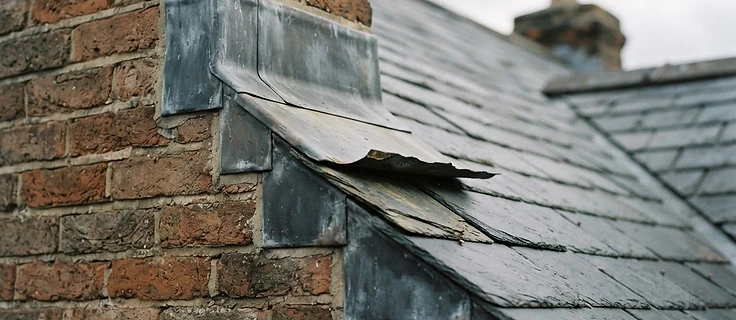
The most common single cause. Lead that has lifted, split or come out of its mortar joint lets water straight into the roof structure, as does an old cement fillet that has cracked. Damp from flashing tends to show soon after rain and often appears in the loft on timbers near the stack. See lead flashing repairs.
Open mortar joints
Once joints have weathered back, wind driven rain gets into the body of the stack and soaks through. This kind of leak often takes longer to show, may fade between wet spells, and can stain higher up the chimney breast. Repointing is the usual remedy.
Damaged or porous brickwork
Bricks that have spalled have lost their weathered face, so they absorb far more water than they were meant to. On an exposed stack, that alone can be enough to cause internal damp.
Pots, cappings and flaunching
Cracked flaunching at the top lets water sit in the head of the stack. An open or unlined flue, or a badly fitted cap, can allow rain straight down the flue. Where a chimney has been capped without ventilation, the damp can be condensation rather than rainwater, which is a different problem with a different fix.
Roof defects near the stack
A slipped or cracked slate a course or two below the chimney produces damp in exactly the place people expect a chimney leak. Blocked valleys, failed mortar bedding on ridge tiles and defective soakers close by all do the same.
What to look for from a safe position
- Whether the damp appears within hours of rain, or days later
- Whether it only follows rain driven from one direction
- Damp on loft timbers, and whether it is at the stack or on the roof slope
- Visible gaps in mortar joints or lead when viewed from ground level with a zoom lens
- Debris in the gutter below the stack
- Whether the flue is in use, capped or redundant
What affects the work needed
A single loose flashing is a small job once access exists. A stack with open joints, damaged bricks and tired leadwork is a bigger piece of work, and it usually makes sense to do it all while the scaffold is up rather than return twice. Height, access and roof pitch drive much of the cost, which is why the same repair can differ between two houses on the same street.
Before you agree to a repair
Ask what the leak has been attributed to and why. If the answer is vague, or the proposed work covers everything at once without explanation, it is fair to ask for the reasoning. Our before you decide page sets out how to work through it, and describing what you've seen, along with photographs if you have them, is a good starting point.