What repointing actually is
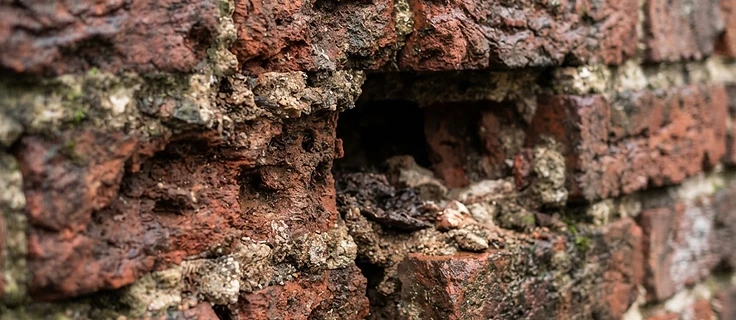
Mortar is the sacrificial part of any masonry. It is meant to weather before the brick does. On a chimney stack it does that faster than anywhere else on the house, because the stack is exposed on all four sides and has nothing above it. Repointing means raking out the old, failed mortar to a sound depth and refilling the joints with fresh mortar, finishing them so water runs off rather than sitting in the joint.
The depth matters. Scraping a thin skim of new mortar over a soft, hollow joint hides the problem for a season or two and then falls out, often taking a little more of the brick arris with it. A joint raked back properly gives the new mortar something to key into.
Signs you might notice
- Joints that look recessed or hollow compared with the face of the brick
- Mortar that crumbles or can be picked out with a finger or a key
- Sandy grit or small lumps of mortar collecting in the gutter or on the roof below
- Damp patches on the chimney breast inside, often worst after driving rain
- Vegetation or moss taking hold in open joints near the top of the stack
- Brick faces beginning to flake where water has been sitting in the joints
Why the mortar fails
Weather does most of it. Cumbria gets a lot of rain and plenty of wind to drive it into the masonry, followed by cold spells that freeze whatever the joint has soaked up. Repeat that for a few decades and the joint erodes. Where an old lime bedded stack has been repointed at some point with a strong cement mortar, the failure can be quicker and less even, because the harder mortar traps moisture and forces it out through the softer brick instead.
Height and orientation play a part too. On most Carlisle stacks the prevailing side has visibly worse joints than the sheltered side, and the top few courses tend to go first.
Options to consider
For a stack with sound bricks and weathered joints, repointing the affected faces is usually the sensible answer. Where only the top courses have gone, a partial repoint can be reasonable, though if access is being paid for it is often better value to deal with the whole stack while the scaffold is up. If a number of bricks have broken down, repointing alone is not the right job and stack repairs or partial rebuilding should be discussed.
Mortar choice is worth raising with whoever quotes. On traditional brick and sandstone, a mix with lime in it moves and breathes closer to the original construction. On a 1970s stack, a standard sand and cement mix is usually appropriate. There is no single correct mortar for every property.
What affects complexity and cost
- Height of the stack and whether it sits above the ridge
- Access, and whether a scaffold, tower or roof ladder is needed
- How many faces of the stack need doing
- Depth the joints have to be raked back
- Any bricks that have to be cut out and replaced
- Whether the flaunching, pots or leadwork need attention at the same time
When to look at it
Open joints do not fix themselves, and every wet winter takes them further back. If mortar is visibly missing or debris is appearing below the stack, it is worth dealing with while the work is still pointing rather than rebuilding. Where damp is already showing inside, sooner is better.
Before agreeing to the work
Ask what mortar mix will be used and why, how deep the joints will be raked, whether the price includes brick replacement if any are found to be damaged, and whether access is included or extra. Our before you decide page covers this in more detail, and telling us what you've noticed is the quickest way to start.