What the flashing does
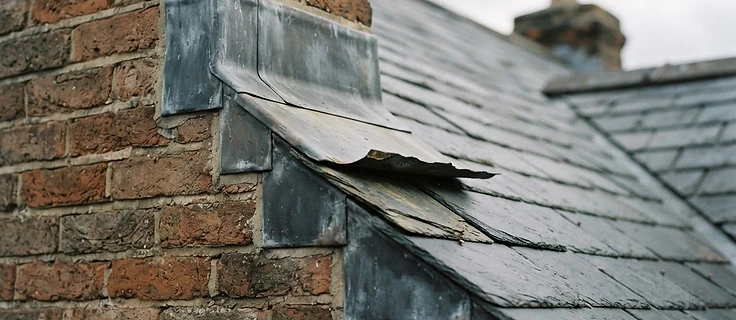
Where a chimney passes through a roof, there is a joint between two materials that both move. Lead is used to bridge that joint because it can be dressed to shape and tolerate movement. On a typical stack there is an apron at the front, stepped flashings up each side tucked into the mortar joints, and a back gutter behind. Each part has to overlap correctly for water to be shed onto the roof covering rather than into the structure.
Signs of failing leadwork
- Lead that has lifted away from the brickwork or pulled out of its joint
- Splits, tears or ripples in the lead, often at fold lines
- Old mortar fillets crumbling away where lead should have been used
- Cement or mastic smeared over the junction as a previous quick fix
- Damp in the loft on the roof timbers close to the stack
- Staining on the ceiling or chimney breast that worsens with wind driven rain
Why it fails
Lead has a long life, but the fixings and pointing that hold it do not always last as well. Wind gets under a loose edge and works it free. Thermal movement fatigues lead that has been laid in over long lengths without joints. Where the original leadwork was replaced with a sand and cement fillet, it cracks as the stack and roof move independently, and once cracked it channels water inwards. On older Carlisle properties it is common to find several generations of repair layered over each other.
Telling a flashing leak from a masonry leak
The two often look identical from indoors. A few pointers help. Flashing leaks tend to appear soon after rain and frequently show at the point where the stack passes through the roof, or on loft timbers. Leaks through open mortar joints and porous brick usually take longer to appear, affect the stack above the roof and can leave damp higher up the chimney breast. Neither is conclusive on its own, which is why looking at the whole junction, the slates nearby and the stack together is worth doing. Our leaking chimney page works through the other possibilities.
Repair options
A localised repair can be reasonable where a single flashing has come loose and the rest of the leadwork is sound. It is redressed, refixed and repointed into the joint. Where the lead has split, is undersized or was never properly formed, renewing the flashing in appropriate lead sizes is the more durable option. If the mortar joints holding the stepped flashing are soft, they need attention at the same time, which is where repointing often gets included. Cement fillets are best treated as temporary rather than a solution.
What affects cost
- Whether one flashing or the whole junction is being renewed
- Whether a back gutter is involved, which is more involved than an apron
- Slates or tiles that have to be lifted and reinstated
- Condition of the mortar joints receiving the lead
- Roof height, pitch and access for scaffolding
- Any masonry work carried out at the same time
When to deal with it
Water in a roof structure is worth stopping early. Prolonged leaks around a stack lead to damp plaster, decayed timber and staining that keeps coming back after decoration. If damp appears near the chimney in the loft, it is better looked at before the wetter months.
Before you agree to the work
Ask which parts of the leadwork are being renewed, whether roof coverings are being lifted, and whether pointing is included. Reading before you decide first is worthwhile, and you can describe the damp you've seen here.